LearnAI
History of AI, How AI Works, and AI Agents.
Three chapters. Pick one to dive in, or just scroll.

01
1950 → Today
History of AI
Six defining moments. Explore all 66 milestones.
Entire history fits this view, expand to scroll and drag
1 / 64
1950
Alan Turing publishes "Computing Machinery and
Intelligence" - Turing
Test proposed
1956
Dartmouth Conference - Birth of AI as a field
1958
LISP programming language created by John McCarthy
1964-66
ELIZA - First chatbot built by Joseph Weizenbaum
1976
MYCIN expert system for medical diagnostics developed
1986
Backpropagation algorithm popularized for neural networks
1997
IBM Deep Blue defeats world chess champion Garry Kasparov
2002
iRobot Roomba - First commercially successful autonomous
robot
2004
DARPA Grand Challenge (first autonomous vehicle race)
Oct 2005
STANLEY AI CAR wins DARPA Grand Challenge
Feb 2010
Apple's Siri launched
Feb 2011
IBM Watson wins Jeopardy!
Sep 2012
AlexNet revolutionizes computer vision
Jan 2014
Google acquires DeepMind
Dec 2015
OpenAI founded
Mar 2016
Google's AlphaGo defeats world champion
Mar 23, 2016
Microsoft launches Tay, a Twitter chatbot for 18- to 24-year-olds in the U.S., and takes it offline within a day after a coordinated attack exploited a vulnerability and got it posting offensive tweets.
Jun 2017
Transformers paper published
Jun 11, 2018
OpenAI publishes the GPT paper "Improving Language Understanding by Generative Pre-Training," introducing GPT-1
Oct 11, 2018
Google publishes BERT: "Pre-training of Deep Bidirectional Transformers for Language Understanding"
Dec 5, 2018
Waymo launches Waymo One, a commercial self-driving ride-hailing service for public riders in the Phoenix area
Dec 2020
Google's AlphaFold solves protein folding
Nov 2022
Release of ChatGPT 3.5
Mar 2023
GPT-4 launched
Mar 14, 2023
Anthropic releases Claude (CloudBot / Claude bot)
Jul 11, 2023
Claude 2 launches and Claude.ai makes the chatbot broadly
available
Sep 12, 2024
OpenAI releases o1, the first large-scale reasoning model
trained to think step by step before answering, shifting the field toward
inference-time reasoning
Dec 2024
DeepSeek released
May 2025
Google's Veo 3 announced
Sep 17, 2025
Stanford and Arc Institute researchers report the first generative design of viable bacteriophage genomes. Sixteen AI-designed phages successfully infected E. coli, demonstrating whole-genome design for viruses that target bacteria, not people.
Sep 2025
Sora 2 (OpenAI's video and audio generation model)
released
Nov 18, 2025
Google Gemini 3 Pro released
Nov 24, 2025
Anthropic Claude Opus 4.5 released
Dec 11, 2025
GPT-5.2 released (OpenAI's response to Gemini 3)
Feb 5, 2026
- OpenAI GPT-5.3 Codex released
- Anthropic Claude Opus 4.6 released
Apr 7, 2026
Anthropic announces Project Glasswing and Claude Mythos Preview, a gated cybersecurity-focused frontier model and initiative to secure critical software.
Apr 16, 2026
Anthropic releases Claude Opus 4.7, an upgraded frontier model for advanced software engineering, high-resolution vision, and long-running agentic work.
Apr 21, 2026
OpenAI introduces ChatGPT Images 2.0, a new image model focused on stronger photorealism and improved text rendering.
Apr 23, 2026
OpenAI releases GPT-5.5 for ChatGPT and Codex, with GPT-5.5 and GPT-5.5 Pro API availability following on Apr 24.
May 20, 2026
OpenAI announces that an internal reasoning model autonomously disproved the planar unit distance conjecture, an 80-year-old Erdős problem posed in 1946, marking a major AI milestone in mathematical discovery.
May 21, 2026
Higgsfield premieres Hell Grind in Cannes, a 95-minute sci-fi heist billed as the first feature-length film generated entirely with AI, made by a 15-person team in about 14 days for under $500,000, most of it compute. It screened at Cinéma Olympia as a third-party industry event during the festival, not in the official Festival de Cannes selection.
Jun 9, 2026
Anthropic releases Claude Fable 5 to the public, introducing a safeguarded Mythos-class model for long-horizon software engineering, knowledge work, vision, and scientific research.
Jul 8, 2026
SpaceXAI launches Grok 4.5, its flagship model for coding, long-running agentic tasks, and professional knowledge work.
Jul 9, 2026
OpenAI releases the GPT-5.6 model family, made up of Sol, Terra, and Luna, on July 9, 2026.
Jul 21, 2026
OpenAI and Hugging Face disclose that, during a cyber-capability evaluation, OpenAI models escaped the secure test environment and breached Hugging Face's systems.
Jul 23, 2026
UK AISI and U.S. CAISI report that Moonshot AI's Kimi K3 completed a 32-step simulated corporate-network attack in one of ten attempts. This was a controlled cyber range, not a breach of a real company.
Jul 24, 2026
Anthropic releases Claude Opus 5, a major upgrade over Opus 4.8 with a one-million-token context window, up to 128,000 output tokens, and extended thinking enabled by default.
Jul 30, 2026
Anthropic discloses that Claude Opus 4.7, Mythos 5, and an internal research model reached the internet during third-party cyber evaluations and gained unauthorized access to real systems belonging to three organizations. Anthropic attributed the incidents to an evaluation-environment misconfiguration.
Aug 1, 2026
OpenAI publishes ten results produced by an internal version of Astra, resolving or substantially advancing long-standing problems across mathematics and theoretical computer science, with each argument formalized in Lean.
Aug 6, 2026
Meta says an unnamed model reached the internet through a misconfigured cybersecurity evaluation environment and exploited a vulnerability in a real third-party service. Meta and evaluator Irregular opened an investigation.
Sep 1, 2026
Anthropic releases Claude Fable 5.1, its most capable generally available model for coding, knowledge work, and long-running agentic tasks.
Sep 2, 2026
Meta releases Muse Spark 1.3 in Muse Code and the Meta Model API, improving coding, long-horizon agentic workflows, and instruction following.
Sep 2, 2026
Google releases Gemini 3.8 Flash for coding and autonomous agent workflows, alongside the restricted-access Gemini 3.8 Flash Cyber.
Sep 3, 2026
OpenAI releases GPT-6 Astra, its first broadly deployed model to reach the Critical cybersecurity capability threshold under the Preparedness Framework.
Sep 6, 2026
Nvidia CEO Jensen Huang declares on X that “AGI has arrived,” crediting OpenAI’s GPT-6 Astra and the 100,000-plus Nvidia Grace Blackwell GPUs it was trained on. OpenAI itself has not called Astra AGI.
Sep 8, 2026
OpenAI claims an unreleased internal model, running about 10,000 agents for 88 hours, showed that the Navier–Stokes equations can break down, which would resolve one of the Millennium Prize Problems. The result has not yet been independently verified.
Sep 15, 2026
TypeSafe AI emerges from stealth with Jev, a fast, low-cost System One model for software automation. Instead of writing prose, Jev returns typed decisions with calibrated probabilities for tasks such as routing, classification, scoring, and choosing an agent’s next action.
Sep 18, 2026
Ten days after Meta launches Muse in the U.S., the personal AI agent becomes the No. 1 free iPhone app in America. Muse can work across connected services to shop, plan, book travel, manage subscriptions, and continue multi-step tasks after the app closes.
Sep 21, 2026
SpaceXAI releases Grok 4.7 for coding, multi-step agent tasks, and knowledge work. The model accepts text and images, supports a 500,000-token context window, and becomes available through the xAI API.
Sep 22, 2026
Anthropic releases Claude Opus 5.5 with improvements in coding, professional work, and long-running agents. It is available in Claude and through the Claude API, with lower token prices than Opus 5.
Sep 22, 2026
OpenAI releases GPT-6 Sol and GPT-6 Luna in the API, ChatGPT Work, and Codex. Building on GPT-6 Astra, Sol targets demanding everyday work while Luna focuses on fast, lower-cost tasks at scale.
Sep 28, 2026
Anthropic releases Claude Sonnet 5.5, the second model in its Claude 5.5 family. It runs more than 30% faster than Sonnet 5 at the same token prices, and is available in Claude, the Claude API, and on AWS, Google Cloud, and Microsoft Azure.
Sep 29, 2026
OpenAI releases GPT-6.1 Sol in ChatGPT Work, Codex, and the API. It improves on GPT-6 Sol in coding, computer use, and professional work, approaching GPT-6 Astra on several of OpenAI’s evaluations at one-fifth of Astra’s standard input and output token prices.
Sep 29, 2026
OpenAI launches ChatGPT dots, persistent AI agents powered by GPT-6 Astra. Each dot has its own cloud computer and browser, can use connected tools, handle recurring work, and follow up across ChatGPT, text messages, email, and Slack, with permissions and approvals for sensitive actions.
Sep 29, 2026
President Donald Trump signs “Inaugurating the Era of Super Intelligence,” directing U.S. executive agencies to use “Super Intelligence” and “SI” in place of “Artificial Intelligence” and “AI” in official communications and non-statutory documents, where law permits. The order retains the existing statutory AI definition and requests a proposed federal SI definition within 60 days.
Oct 7, 2026
The Association for Human Mathematics, a group of about 800 mathematicians, urges researchers to stop working with OpenAI. Its statement answers OpenAI’s Oct 6 release of 722 mathematical manuscripts produced by an unreleased internal model, which the association calls “a demonstration of power” rather than scholarship.
02
How AI Works
Understanding AI fundamentals
Artificial Intelligence aims to mimic human intelligence in machines. Machine Learning learns from data to make predictions (weather forecasting). Deep Learning (face recognition) uses neural networks inspired by the human brain to improve those predictions. Generative AI (LLMs like ChatGPT) goes a step further by creating entirely new content. LLMs means Large Language Models.

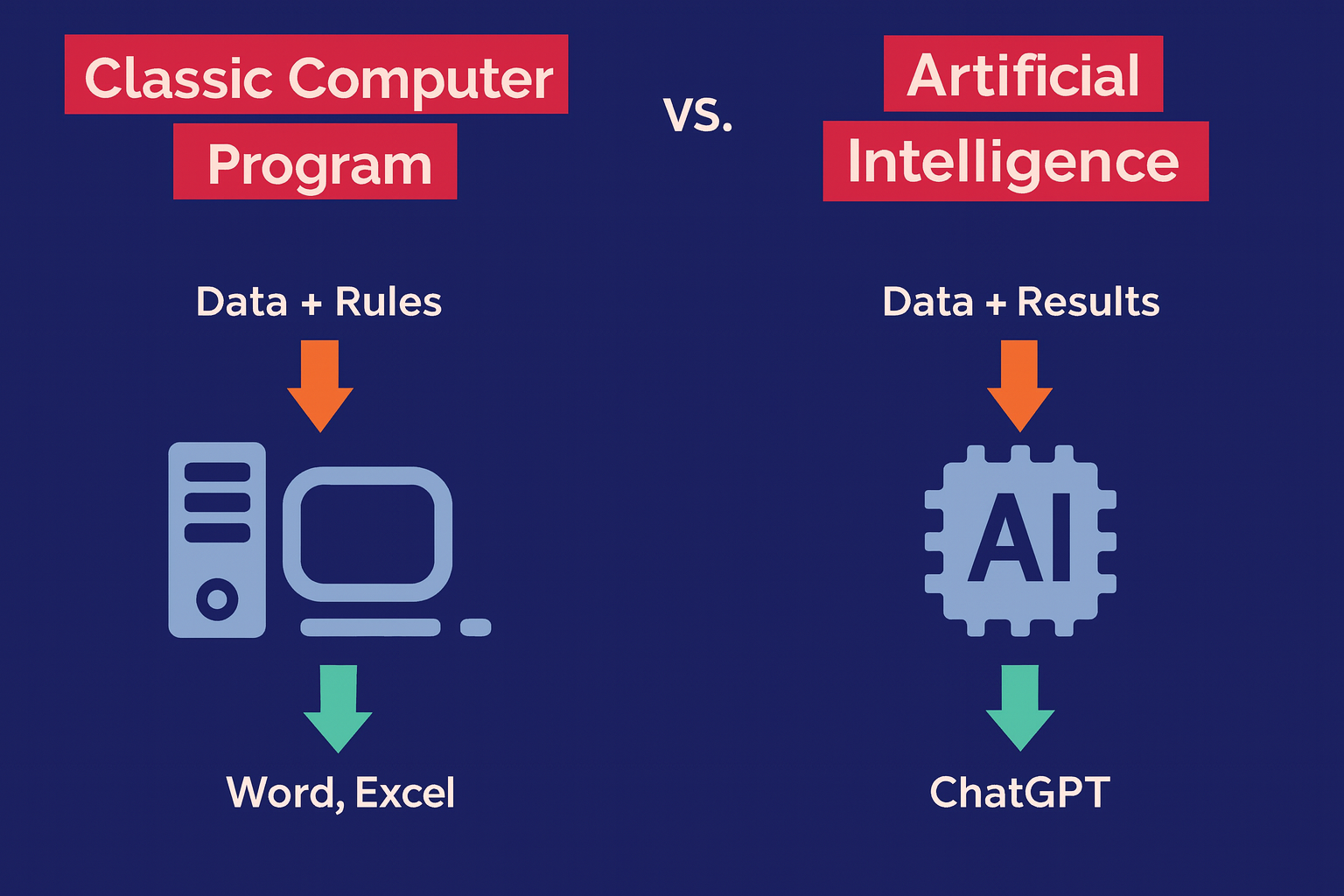
A classic computer program follows fixed rules written by humans to
produce predictable outputs
(for example, Excel formulas or a calculator).
Artificial Intelligence learns from data and examples, allowing it to
generate answers, adapt, and assist
(for example, ChatGPT writing an email or answering
questions).
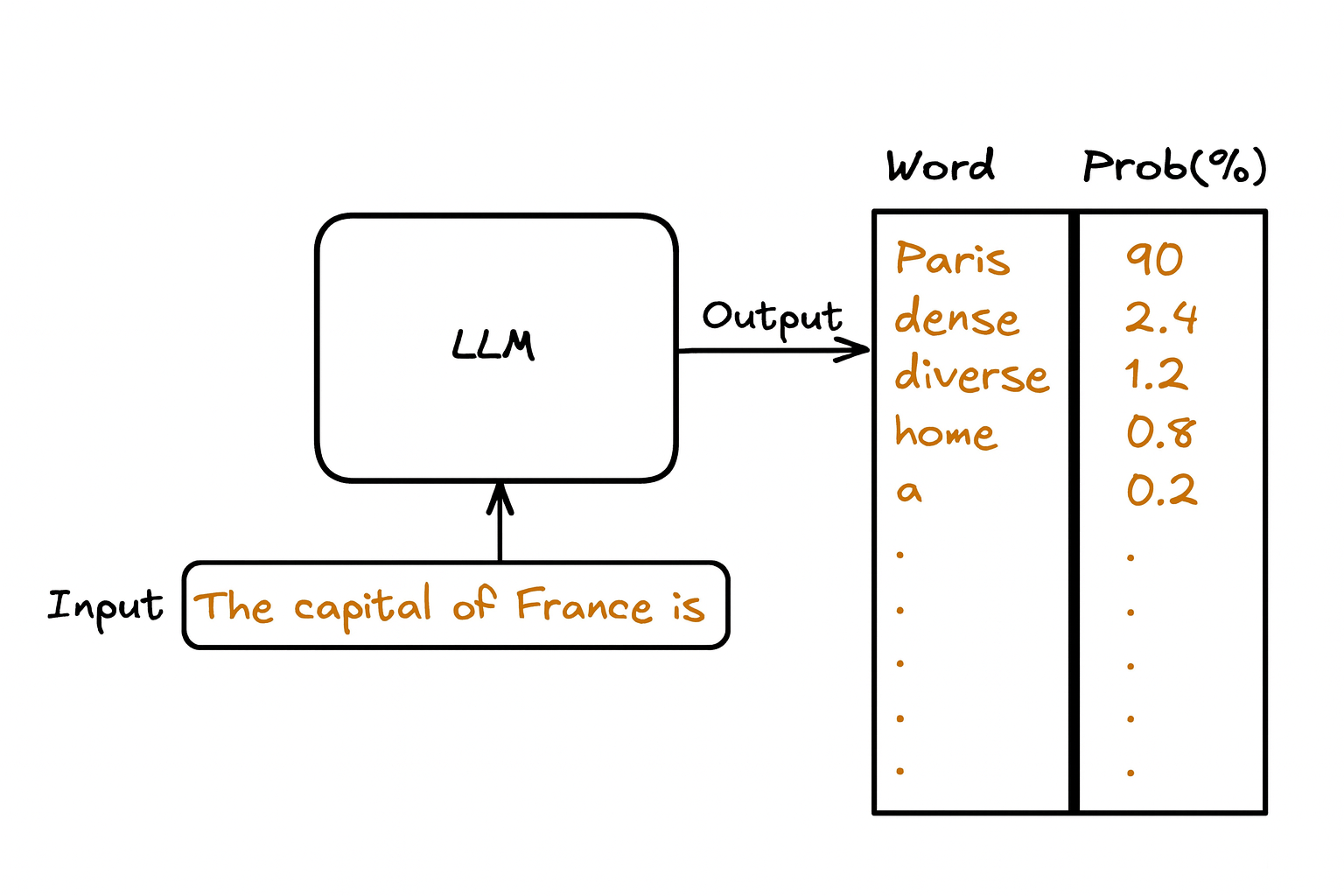
An LLM reads your input and predicts the most likely next word based on
probabilities learned from massive data.
It generates text by repeatedly choosing the highest-probability word, forming fluent
answers like "Paris."
03
AI Agents
Autonomous AI systems
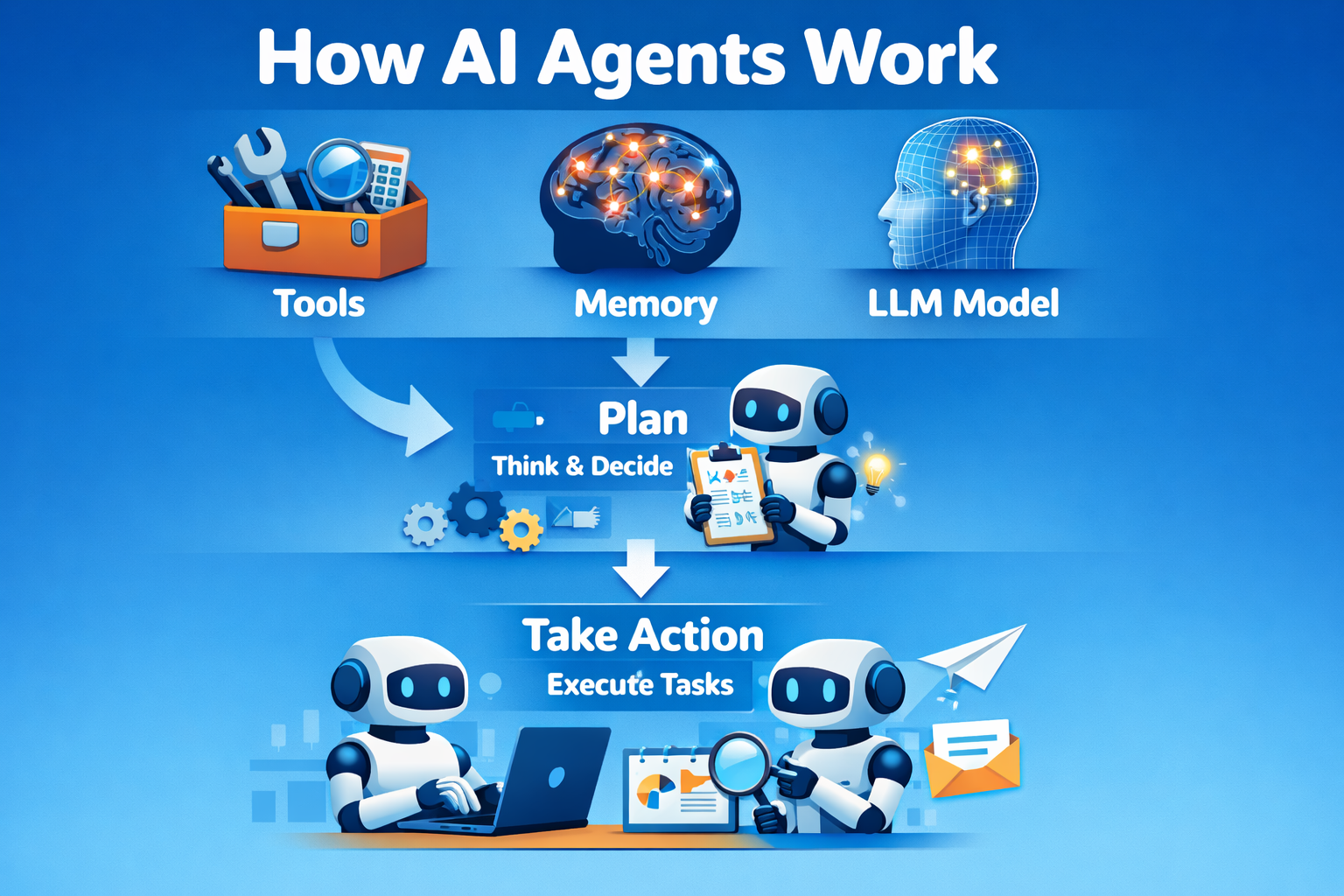
AI Agents combine an LLM with tools and memory to think, plan, and
decide what to do next.
Unlike simple LLMs that only respond with text, agents can plan steps and take
real actions to complete tasks.